By Xiao Liu and his AI agent
When AI Splits the Gains: Preparing for an AI Wealth Gap
AI might make a few people wealthy much faster than everyone else, at least at first. Here's how governments have responded to big economic shifts before, and what that history suggests about preparing for one.
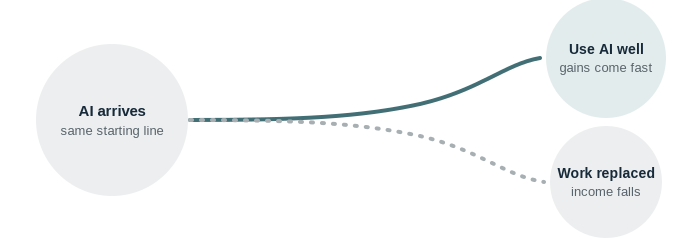
New technology rarely makes everyone richer at the same time. People who use AI well might pull ahead fast, while others lose jobs and income.
If that happens, who keeps the gains, and what will governments do about it?
I've been learning how the economy works, from credit and debt to productivity. While I took notes, one question kept coming back: what happens if AI's gains reach only a few people first?
Two ideas that explain the worry#
Ray Dalio's video How the Economic Machine Works explains the economy with a few simple ideas [1]. Two of them are enough to follow the rest of this post.
Your spending is someone else's income
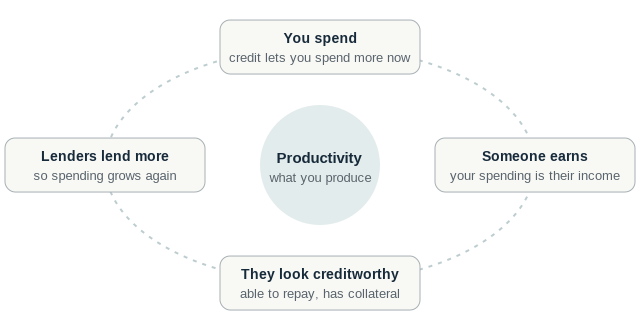
An economy is the sum of all its transactions. Every dollar you spend is a dollar someone else earns. So when most people produce more and earn more, they also spend more, and the whole economy grows.
The same idea explains inflation, in simplified form: when spending grows faster than the goods and services available, prices tend to rise across the economy [1].
Borrowing is spending your future income today
Credit lets you spend more than you earn now. Later, you have to spend less than you earn to pay it back. That is why the economy moves in cycles instead of a straight line [1].
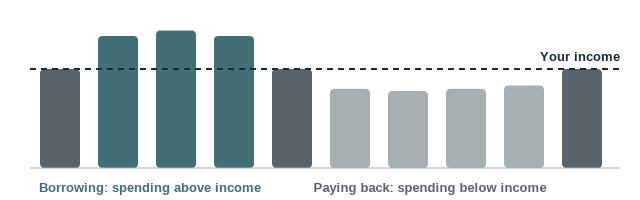
Debt stays manageable while income keeps up with it. That's why lenders ask two things: can you repay from your income, and do you own something valuable they could claim if you don't? Dalio's illustration is a farmer who borrows for a tractor that harvests more crops, compared with someone who borrows for a big TV [1]. It's a simplification. A tractor can still fail to earn enough, and the real risk of any loan also depends on its cost, its terms and the borrower's income.
Why AI might split the gains at first#
The machine grows fastest when most people become more productive. AI might not work that way, at least at first:
- People who can use AI well might do far more work and earn far more.
- Others might lose jobs or income, so they spend less.
- Since one person's spending is another person's income, falling spending on one side can slow the whole economy, even while the other side gets richer.
This is a possibility, not a settled forecast. The IMF describes outcomes that depend on whether AI replaces workers or helps them, and on how widely the productivity gains spread. It also notes that higher returns to owners of capital could widen wealth gaps [12]. An ILO review finds productivity gains that are real but uneven, and limited large-scale job displacement so far [13].
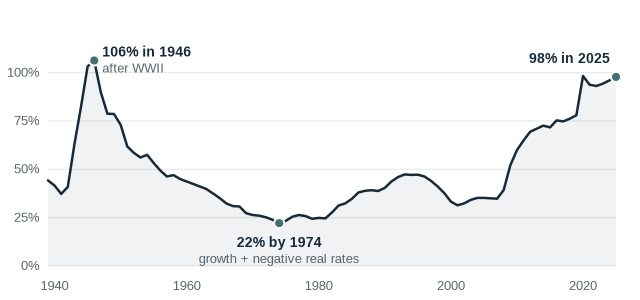
So the hope that AI will raise productivity fast enough to grow the US smoothly out of its debt might not hold. Federal debt held by the public was about 98% of GDP in 2025 [2]. GDP is the value of everything the country produces in a year, so that's government debt almost as large as a full year of the whole economy's output. The record was 106%, in 1946.
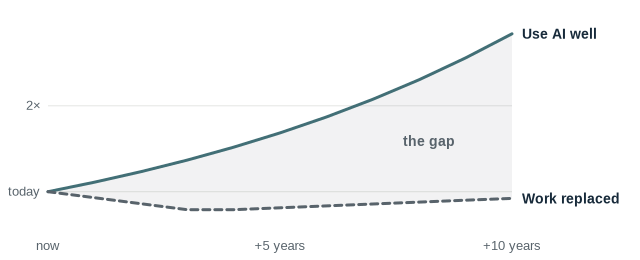
People on both sides of a gap would have reasons to plan:
- If AI is raising your income, the question is how to keep the gains, because new policies often aim at the winners.
- If AI is squeezing your work, the question is how to protect what you have and move toward the side that's gaining.
Five possible responses to uneven AI gains#
In Dalio's model, a government with too much debt has four main ways to bring it down: cut spending, reduce or restructure debts, redistribute wealth, and print money [1]. Uneven AI gains could push governments toward any of them. They might also respond to AI's effects directly, for example with worker support or new rules for the technology. That fifth kind of response targets the gap, not the debt.
History has an example of each. They are precedents, not proof of what will happen this time.
| Possible response | A past example | Who tended to gain or lose |
|---|---|---|
| Print money and keep real interest rates low | After WWII, caps on interest rates and tight financial rules kept real interest rates (interest after inflation) negative in many years. Together with growth, that helped cut US debt from 106% of GDP in 1946 to 22% by 1974 [2][3]. After 2008, central banks used quantitative easing (QE): buying bonds with newly created digital money [7]. | Borrowers on fixed rates gained when inflation ran above their rate. Savers earning less than inflation lost buying power [3]. QE lowered borrowing costs and tended to lift asset prices, with effects that varied from household to household [1][7]. |
| Tax and redistribute the gains | After the Gilded Age, the US added a federal income tax in 1913, with a top rate of 7% [4][5]. The top marginal rate reached 94% in 1944 and stayed above 90% from 1951 to 1963 [4]. | That rate applied only to income above the top bracket, so top earners didn't pay it on all their income. What they actually paid depended on brackets, deductions and other rules [11]. |
| Cut spending | The UK's planned public-service cuts from 2010 were, by IFS analysis, the deepest sustained squeeze since World War II [6]. | Public services and benefits shrank, though who lost most depends on how services are counted. The cuts also ran alongside QE [7]: a mix, not one tool. |
| Restructure the debt or devalue the currency | In 1933 Congress cancelled gold clauses in contracts. In 1934 the official gold price went from $20.67 to $35 an ounce, cutting the dollar's gold value to 59% of its old level [8]. | Creditors who had been promised payment in gold, or its value, lost that protection. The Supreme Court later ruled on how the change applied to private contracts and government bonds. |
| Respond to AI's effects directly (not a debt tool) | Antitrust law in 1890 followed the rise of giant trusts like Standard Oil, which was broken up in 1911 [9]. Trade Adjustment Assistance, since 1962, has offered training and income support to workers who lost jobs to trade [10]. | The largest companies faced limits, and some displaced workers got help. These are analogies: they don't show what AI policy will be or how well retraining would work this time. |
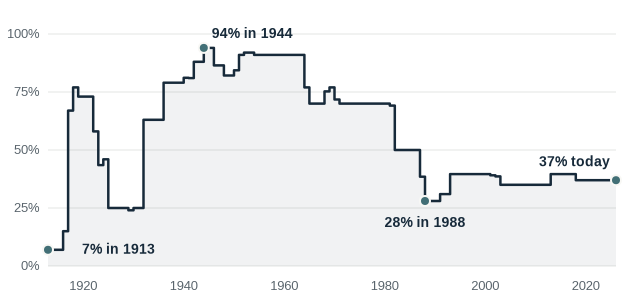
Here's how each might look this time, as possibilities rather than forecasts:
- Print money. If AI job losses slow the economy, the central bank would likely cut rates and might restart QE. With debt near 100% of GDP, keeping real interest rates low would quietly shrink it, as it did after WWII.
- Tax the gains. Higher taxes on top incomes, investment gains, or the companies that profit most from AI. Ideas like a tax on automation, or a basic income paid for by it, could get more attention.
- Cut spending. Harder to rely on while many people are losing income, because cuts hit them first. More likely in small pieces than as the main tool.
- Restructure debt. The least likely for the US, which borrows in its own currency. Inflation can do a similar job more quietly [3].
- Respond to AI directly. Retraining and income support for displaced workers, limits on the largest AI companies, and rules on how AI is used at work.
The most likely outcome is a mix. Dalio calls a well-balanced mix a "beautiful deleveraging": debt falls compared with income, the economy still grows, and inflation stays under control [1]. If I had to guess, this mix will lean on printing money and taxing the gains.
Questions worth asking before the mix arrives#
Nobody knows which mix will come, or when. So instead of betting on one scenario, it helps to ask which choices would hold up under several of them over the next eight to ten years. These are general questions to consider, not personal recommendations; see the disclaimer at the end.
01Do you have a safety cushion?
Each response in the table squeezed someone, through inflation, spending cuts or lost work. A cushion of savings means a bad year doesn't force you to sell, or borrow, at the worst time. It's the simplest way to avoid risking what you need for what you don't need.
What it can look like savings that cover several months of costs, kept apart from money you invest.
02How would your debt behave if inflation or interest rates rose?
The postwar years show that when inflation runs above the interest on a fixed-rate loan, the loan gets lighter in real terms [3]. When central banks raise rates to fight inflation, the payments on variable-rate debt go up.
What it can look like knowing which of your debts are fixed-rate and which are variable, and keeping payments well below what your income can carry. Dalio's first rule says the same: don't let debt rise faster than income [1].
03Is everything riding on one scenario?
Each response in the table rewarded different people, and few saw it coming in advance.
What it can look like spreading savings across different kinds of assets (cash, bonds, stocks and real assets) instead of betting everything on one.
04Would you be able to borrow on good terms if you needed to?
In Dalio's machine, lending starts again once borrowers look creditworthy: able to repay from income, with something of value behind them [1]. When borrowing gets cheaper, people with steady income and a good repayment record are the ones who can use it.
What it can look like steady income, a clean payment history, and debt that stays low compared with income.
The long-term answer: raise your productivity, including with AI#
Over the next decade, policy decides a lot. Over decades, productivity decides more. Dalio ends his video with three rules of thumb, and says they apply to individuals as much as to governments [1]:
- Don't let debt rise faster than income.
- Don't let income rise faster than productivity.
- Do all you can to raise your productivity.
Higher productivity doesn't guarantee a higher income. Who owns the tools, whether AI helps or replaces a given kind of work, and policy all shape who benefits [12].
What it can look like produce something others want, then use AI to get more productive at producing it. Learning AI is one way I'm trying to raise my own productivity.
What's next#
These are possibilities, and the future rarely follows one script. If you see a different scenario coming, or you're preparing in a way that isn't listed here, I'd love to hear about it.
Two questions are still open:
- Can AI lift most people's productivity, not just a few?
- If the gap opens, which mix will governments choose, and how soon?
Which of the five responses do you think is most likely, and how would you prepare for it? Share your thoughts in the comments below, or reach out to me directly through my contact page. Your view might help other readers too.
References#
- Ray Dalio, How the Economic Machine Works (video, 2013, about 30 minutes).
- Federal Reserve Bank of St. Louis (FRED), Federal Debt Held by the Public as Percent of GDP.
- Carmen Reinhart and M. Belen Sbrancia, The Liquidation of Government Debt, NBER Working Paper 16893 (2011).
- Tax Policy Center, Historical Highest Marginal Income Tax Rates.
- National Archives, 16th Amendment to the U.S. Constitution: Federal Income Tax (1913).
- Institute for Fiscal Studies, The IFS Green Budget, February 2012.
- Bank of England, Quantitative easing.
- Federal Reserve History, Gold Reserve Act of 1934 and Roosevelt's Gold Program.
- National Archives, Sherman Anti-Trust Act (1890).
- Congressional Research Service, Trade Adjustment Assistance for Workers.
- Tax Policy Center, How do federal income tax rates work?
- International Monetary Fund, Gen-AI: Artificial Intelligence and the Future of Work, Staff Discussion Note (January 2024).
- International Labour Organization, The impact of GenAI on jobs, productivity and work organization: a review of the empirical evidence (June 2026).
Comments